
Hero product
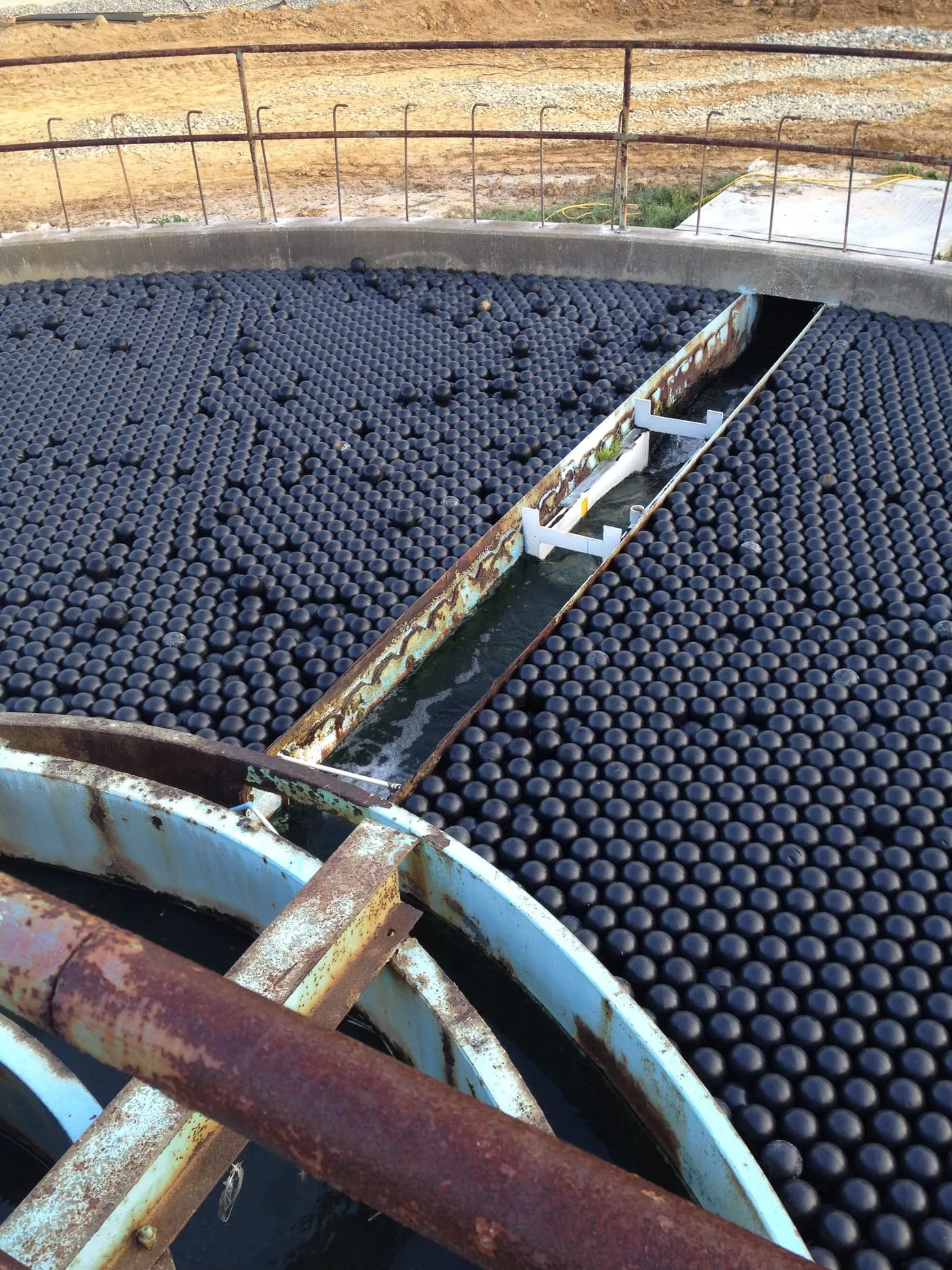
Armor Ball® — the heaviest-duty shade ball & hollow plastic ball cover
Specifications
Confirmed Armor Ball® specifications
Per AWTT published data. All figures render from a single source-of-truth data file.
| Surface coverage | 91% |
|---|---|
| Ball diameter | 100 mm (4 in) |
| Ball weight (dry) | 50 g |
| Density | 10 balls/ft² (108/m²) |
| Buoyancy | 10.9 lb/ft² (53 kg/m²) |
| Wind resistance | 35 MPH (56 km/h) |
| Evaporation reduction | up to 90% |
| Heating-cost reduction | up to 70% |
| Operating temperature | −70°F to +160°F (−57°C to +71°C) |
| Material | Pure UV-stabilized HDPE — virgin blended with traced, tested recycled HDPE (no other plastics mixed in) |
| Chemical resistance | Excellent; inert to most industrial liquids (pH 2–13) |
| Insulation | R-2 |
| Life expectancy | 25+ years |
| Warranty | 10 years (manufacturer) |
| Maintenance | None |
| Installation | Tool-free — pour onto the surface; self-interlocking; self-adjusting |
Benefits
Why specifiers choose Armor Ball®
Up to 90% less evaporation
A dense 91% floating layer chokes off the open water surface, cutting evaporative water loss up to 90% — water and dollars kept in the pond.
Algae & cyanobacteria control
Blocking sunlight at the surface starves photosynthesis, suppressing algae and cyanobacteria blooms without adding chemicals.
Odor & VOC suppression
The cover acts as a physical barrier that suppresses odor, H₂S, and VOC emissions rising off the liquid — easing nuisance and compliance pressure.
Bird & wildlife deterrent
A covered surface deters waterfowl and wildlife, reducing contamination and the cleanup and compliance costs that follow.
R-2 thermal insulation
The floating layer insulates the surface at R-2, cutting heat loss and reducing heating costs up to 70% in temperature-sensitive processes.
Extreme chemical & temperature resistance
UV-stabilized HDPE is inert to most industrial liquids across pH 2–13 and holds up from −70°F to +160°F.
Zero maintenance
Once poured, the cover self-adjusts to changing levels and needs no maintenance — no draining, no servicing.
Tool-free install
No anchors, cables, liners, or heavy equipment. Pour the balls onto the surface and they self-arrange into an interlocking cover.
Materials & compliance
UV-stabilized HDPE, documented on request
Armor Ball® is molded from pure UV-stabilized HDPE — no other plastics mixed in — blending virgin resin with traced, tested recycled HDPE. Per AWTT, it is the only maker of floating modular covers that tests its recycled feedstock for contaminants, so the recycled content is of known, verified source rather than mixed, unverified scrap. The HDPE is specified for potable-water/food-contact use when required; material certifications, SDS, and NSF/ANSI 61 documentation where applicable are available on request.
- Blocks UV to control algae and cyanobacteria
- Suppresses odor, H₂S, and VOCs
- Deters waterfowl and wildlife
- Lets rain and snow pass through
- Balls can be pushed aside for equipment access, then re-cover automatically
- Not damaged by ice or snow
- Works in any pond geometry
Installation
Tool-free, in four steps
- 1 Calculate quantity Use the surface area of your pond or tank to determine how many balls you need — about 10 balls per ft² (108/m²).
- 2 Deliver in bulk Balls ship in bulk and unload quickly; no special equipment or site prep is required.
- 3 Pour onto the surface Pour the balls directly onto the open liquid surface. No anchors, cables, liner penetration, or draining needed.
- 4 Self-arranges into 91% cover The balls float and self-interlock into a dense 91% layer that self-adjusts as the liquid level changes.
Comparison
Armor Ball® vs. commodity shade balls
| Attribute | Commodity shade balls | Armor Ball® |
|---|---|---|
| Construction | Thin-walled | Thicker-walled / reinforced HDPE |
| Weight per ball | 29–40 g | 50 g |
| Plastic / material | Mixed recycled (post-industrial or post-consumer), unverified source — often contaminated, oxidized, and weaker | Pure HDPE — virgin blended with traced, tested recycled HDPE; no other plastics mixed in |
| Primary purpose | Block sunlight | Heavy-duty floating cover (evaporation, UV, odor, insulation) |
| Surface coverage | Varies | 91% |
| Buoyancy | Not typically rated | 10.9 lb/ft² (53 kg/m²) |
| Chemical resistance | Limited | Excellent; inert across pH 2–13 |
| Operating temperature | Not typically rated | −70°F to +160°F |
| Insulation | None rated | R-2 |
| Wind rating | Not typically rated | 35 MPH (75 MPH for AQUA) |
| Life expectancy | Often 3–10 years | 25+ years |
| Warranty | Varies / none | 10 years (manufacturer) |
Weight doesn't lie: a hollow ball is simple geometry, so less weight means less plastic and a thinner, weaker wall — Armor Ball's 50 g carries more material than 29–40 g commodity balls. Armor Ball® also uses pure HDPE with no other plastics mixed in, blending virgin resin with traced, tested recycled HDPE; per AWTT, it is the only floating-modular-cover maker that tests its recycled feedstock for contaminants. Armor Ball® is the lowest-cost, easiest-to-deploy ball cover for sheltered-to-moderately-exposed sites; AWTT's wider range spans 30 MPH to 130+ MPH wind and R-1 to R-17+ insulation.
FAQ
Armor Ball® questions, answered
What is Armor Ball®?
Armor Ball® is the heaviest-duty hollow plastic ball floating cover — a 100 mm (4 in) UV-stabilized HDPE ball that pours onto an open liquid surface and self-arranges into a dense 91% interlocking cover to cut evaporation, block UV, suppress odor, and insulate.
How many Armor Ball® units do I need?
Armor Ball® covers at about 10 balls per ft² (108 per m²). Multiply your surface area by that density — a 1-acre pond (43,560 ft²) needs roughly 435,600 balls. Use the coverage calculator for an exact figure.
How is Armor Ball® installed?
Installation is tool-free: the balls are poured directly onto the liquid surface, where they self-interlock into a 91% layer that self-adjusts to changing levels. No anchors, cables, liner penetration, or draining are required.
What is Armor Ball® made of, and is it safe for potable water?
Armor Ball® is molded from UV-stabilized HDPE specified for potable-water/food-contact use when required. Material certifications, SDS, and NSF/ANSI 61 documentation where applicable are available on request.
What chemicals and temperatures can Armor Ball® withstand?
Armor Ball® is inert to most industrial liquids across pH 2–13 and operates from −70°F to +160°F (−57°C to +71°C) per AWTT published data.
How does Armor Ball® perform in wind?
Standard Armor Ball® is rated for 35 MPH (56 km/h). For more exposed sites, Armor Ball® AQUA uses pre-filled, factory-sealed water ballast to reach 75 MPH (120 km/h).
What warranty does Armor Ball® carry?
Armor Ball® has a 25+ year design life and a 10-year manufacturer warranty per AWTT published data.
How does Armor Ball® compare to a geomembrane floating cover?
Armor Ball® pours on with no anchors, cables, or liner penetration and self-adjusts to level changes, while a geomembrane cover is an engineered, anchored, sealed installation. Choose a membrane for gas-tight containment; choose Armor Ball® for evaporation, UV/algae, odor, and insulation with minimal install and maintenance.
Get a custom Armor Ball® quote
Tell us about your site — surface area, liquid, and goals — and we'll size a cover and respond within 24 hours.
Manufactured by AWTT · 700+ installations · 25 countries · 10-year warranty